

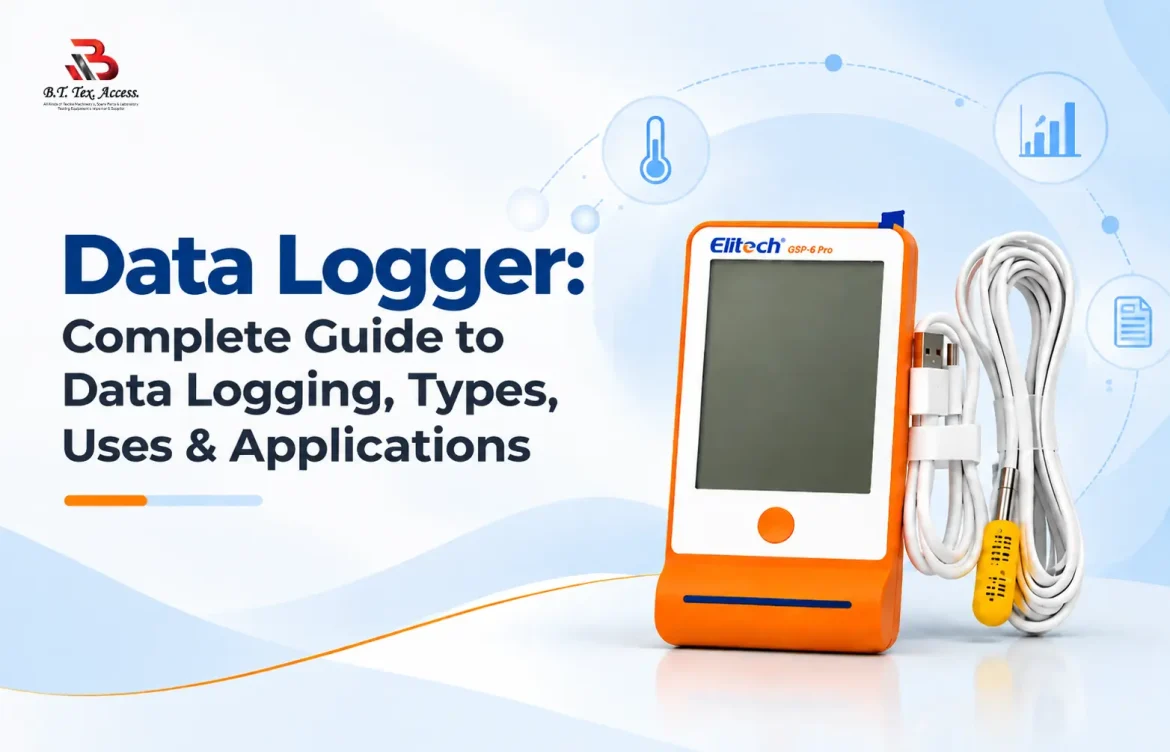
Data Logger: Complete Guide to Data Logging, Types, Uses & Applications
Data Logger: Complete Guide to Data Logging, Types, Uses & Applications
A data logger is a device that automatically measures and records physical or environmental conditions over a period of time. Instead of showing only the current reading, a data logger creates a historical record that can be reviewed and analysed later.
Depending on the model, a data logger may record parameters such as temperature, humidity, pressure, light, voltage, current, shock, or other measurable inputs. Some are designed for a single parameter, while others support multiple channels or sensors.
Data loggers are used in laboratories, textile and garment facilities, warehouses, cold-chain environments, production areas, quality-control operations, research, and other industrial applications where knowing how a condition changes over time is important.
What Is a Data Logger?
A data logger is an electronic device that measures and records data automatically at defined intervals or in response to specified events.
The simplest way to understand it is to compare it with a conventional measuring instrument.
A thermometer might tell you that the temperature is 24.5°C right now. A temperature data logger can record the temperature repeatedly for example, at a selected interval so you can later see how the temperature changed throughout the monitoring period.
The basic purpose is therefore not simply measurement, but measurement plus recording over time.
A typical data logger contains some combination of:
- A sensor or sensor input
- Measurement electronics
- Internal memory
- A clock or time-stamping system
- A battery or other power source
- A method for configuring or retrieving data
- Software or an interface for reviewing recorded information
Many standalone data loggers can collect information without remaining connected to a computer during the entire recording period. Recorded information can then be transferred for review and analysis.
For example, a laboratory may need to know whether room temperature remained within an expected range during an overnight test. Instead of asking someone to manually check and write down the temperature every hour, a suitable data logger can automatically create a time-stamped record.
How Does a Data Logger Work?
Although data loggers vary considerably in design, the basic data logging process is relatively straightforward:
Sensor → Measurement → Logging Interval → Data Storage → Data Retrieval → Analysis
1. Sensor
The sensor detects the physical condition being monitored. Depending on the logger, this could be temperature, humidity, pressure, light, voltage, current, or another input.
2. Measurement
The logger’s electronics convert the sensor signal into a measurable value.
3. Logging Interval
The device records measurements according to a configured interval or logging method. For example, a logger may record at regular time intervals rather than continuously storing every possible instantaneous change.
The appropriate interval depends on how quickly the monitored condition can change and how long the monitoring session needs to run.
4. Data Storage
The measured values are stored in the logger’s internal memory or another supported storage system. Time information is normally associated with recorded measurements so that the data can be understood as a timeline.
5. Data Retrieval
After or during the monitoring period, depending on the device, data can be retrieved using methods such as USB, wireless connectivity, removable storage, or dedicated software.
6. Analysis
The recorded information can then be viewed as readings, tables, graphs, reports, or other formats supported by the logger and its software.
The exact workflow differs between products, but the underlying concept remains the same: capture measurements automatically and preserve them for later review.
What Parameters Can a Data Logger Measure?
Data loggers are not limited to temperature. The measurement capability depends on the sensor, input type, and design of the particular device.
Temperature
Temperature data loggers are among the most common types. They can be used to monitor environments, storage areas, equipment, laboratories, transportation conditions, and other applications where temperature history matters.
Humidity
Humidity data loggers record relative humidity over time. They can be useful when environmental moisture conditions need to be monitored rather than checked only at a particular moment.
Temperature and Humidity
Combination temperature and humidity data loggers monitor both parameters using one device. These are useful when environmental conditions involve both temperature and relative humidity.
Pressure
Pressure data loggers can record pressure changes in equipment, processes, test systems, or other environments where pressure trends need to be documented.
Light
Some data loggers measure light intensity or related optical conditions. These can be used for environmental monitoring, testing, research, or applications where exposure to light needs to be recorded.
Voltage and Current
Electrical data loggers can record voltage, current, or other electrical signals. These can support equipment monitoring, testing, energy-related measurements, and troubleshooting.
Other Inputs
Depending on the design, data loggers may also work with signals associated with:
- Shock or acceleration
- Sound
- Frequency
- Load
- Strain
- pH
- Flow
- Process signals
- Event or state changes
The important point is that a data logger is defined by its ability to record measurements over time, while the actual parameter it measures depends on its sensor or input configuration.
Types of Data Loggers
There is no single type of data logger suitable for every application. Different models are designed around different parameters, environments, channels, connectivity options, and monitoring requirements.
Temperature Data Logger
A temperature data logger is designed specifically to measure and record temperature over time.
Typical uses include storage monitoring, laboratory monitoring, transportation, refrigerators, production environments, and quality-control applications.
Humidity Data Logger
A humidity data logger records relative humidity over a selected monitoring period. It can be useful in environments where moisture levels may affect materials, products, equipment, or laboratory conditions.
Temperature and Humidity Data Logger
A temperature and humidity data logger combines both measurements in one device. This can be useful when environmental conditions need to be monitored from more than one perspective.
For example, the Elitech GSP-6 Pro listed by B.T. Tex. Access is a temperature and humidity data logger with Bluetooth and USB connectivity, configurable recording, LCD display, alarms, and recorded-data storage.
Pressure Data Logger
Pressure data loggers are designed to record pressure measurements over time. Their applications depend heavily on the pressure range, sensor type, accuracy, and environmental requirements of the particular model.
USB Data Logger
A USB data logger uses a USB connection for configuration, data transfer, or both. These devices can be convenient when recorded measurements need to be transferred directly to a computer.
Wireless Data Logger
Wireless data loggers use technologies such as Bluetooth or other wireless communication methods to provide access to measurements or stored information.
The benefit is that the user may not need to physically remove the logger every time data needs to be checked or retrieved, depending on the device and application.
Multi-Channel Data Logger
A multi-channel data logger can monitor several inputs or sensors. This is useful when multiple measurement points need to be monitored during the same test or process.
Multi-channel designs range from relatively simple fixed-input instruments to configurable systems with substantially more inputs.
What Are Data Loggers Used For?
The usefulness of a data logger comes from its ability to preserve a history of measurements.
Laboratories
Laboratories may need to monitor temperature, humidity, equipment conditions, or other environmental variables during experiments, testing, storage, and research.
Instead of relying on occasional manual readings, a logger can provide a record covering the required monitoring period.
Textile and Garment Industries
Textile and garment facilities use measurement and testing meter equipment throughout production and quality-control processes. Data logging can be relevant where environmental conditions, storage conditions, equipment conditions, or test environments need to be monitored over time.
For example, a laboratory or controlled storage area may need historical temperature or humidity information rather than a single measurement.
The exact suitability depends on the application, required measurement range, accuracy, and environmental conditions.
Warehouses and Storage Areas
Storage environments may need monitoring because temperature and humidity can change during different times of the day or under changing operating conditions.
A data logger can create a historical record that helps users understand those changes.
Cold Chain
Temperature-sensitive products may require monitoring during storage and transportation. A suitable temperature data logger can record conditions throughout a defined period, allowing the recorded history to be reviewed afterward.
For cold-chain applications, the correct measurement range, sensor configuration, logging interval, memory, and data-retrieval method should be considered.
Food-Related Applications
Temperature monitoring can be relevant to food storage, transportation, refrigeration, and other controlled environments.
The appropriate device depends on the temperature range and monitoring requirements of the specific application.
Pharmaceutical and Healthcare Environments
Temperature and humidity monitoring can also be relevant to pharmaceutical storage, refrigerators, laboratories, and other controlled environments.
However, organizations operating under specific quality or regulatory requirements should verify that the selected instrument, sensor, calibration documentation, and monitoring procedure meet their own requirements rather than assuming that every data logger is suitable.
Industrial Monitoring
Industrial applications can involve monitoring process variables, equipment conditions, electrical signals, pressure, temperature, or other inputs.
Some industrial data loggers are designed for multiple channels or specialized inputs, while smaller standalone devices may be intended for simpler monitoring tasks.
Quality Control
Historical measurements can support QC investigations by showing whether a monitored condition remained stable or experienced changes during a process, test, storage period, or transportation stage.
Why Use a Data Logger?
A data logger becomes useful when a single measurement is not enough.
Automatic Recording
The logger can record measurements automatically according to its configured logging method, reducing the need for repeated manual recording.
Continuous or Periodic Monitoring
Depending on the device, measurements can be collected at regular intervals over an extended period.
Historical Records
Instead of knowing only the current condition, users can review previous readings and examine how a parameter changed.
Detecting Fluctuations
A historical record can reveal changes that may be missed by occasional manual measurements.
Data Documentation
Recorded measurements can provide documentation for internal review, testing, quality control, maintenance, or other processes.
Reduced Manual Recording
Automatic logging can reduce repetitive tasks associated with manually checking and recording measurements.
Supporting Analysis
Recorded data can be transferred into software or reports, depending on the logger, making it easier to identify trends and unusual changes.
The value is therefore not simply that the device “measures accurately,” but that it can provide structured measurement history for a defined monitoring period.
Data Logger vs Thermometer: What’s the Difference?
A thermometer and a data logger can both measure temperature, but their primary functions are different.
| Feature | Thermometer | Data Logger |
| Current temperature | Yes | Yes, depending on model |
| Automatic recording | Usually not the primary function | Yes |
| Historical temperature record | Limited or model-dependent | Core function |
| Configurable logging interval | Usually not applicable | Common |
| Long-term monitoring | Limited | Common use |
| Data download | Usually not required | Often available |
| Trend analysis | Limited | Supported by many models |
| Typical purpose | Quick measurement | Measurement and historical recording |
For example, if a technician only needs to check the temperature of a machine or room at a particular moment, a thermometer may be sufficient.
If the technician needs to know how that temperature changed during an eight-hour production period, a data logger provides a different type of information.
The choice therefore depends on whether the application requires a reading, a record, or both.
Important Data Logger Specifications
Selecting a data logger involves more than looking at the parameter it measures. The following specifications can affect whether a particular model fits the application.
Measurement Range
The measurement range indicates the minimum and maximum values the logger or sensor is designed to measure.
The required range should cover the actual conditions expected in the application, with appropriate consideration for possible variation.
Accuracy
Accuracy describes how close the measurement is to the actual value under the stated conditions.
For applications where small changes matter, accuracy can become an important selection factor.
Resolution
Resolution describes the smallest measurement increment that the instrument can display or record.
A logger may display values with a fine resolution, but that does not automatically mean its overall accuracy is equally fine.
Logging Interval
The logging interval determines how frequently measurements are recorded.
A shorter interval creates more data points and can capture faster changes, but it also uses memory more quickly. A longer interval reduces the number of stored readings and may be appropriate for slower-changing environments.
Memory Capacity
Memory determines how many measurements can be stored before data needs to be downloaded or the recording session ends.
The required capacity depends on both the logging interval and the length of the monitoring period. As a simple principle, more frequent measurements require more storage for the same monitoring duration.
Battery Life
For portable or standalone monitoring, battery life can affect how long the device can operate without intervention.
The actual operating time can depend on logging frequency, connectivity, display use, environmental conditions, and device design.
Data Transfer Method
Common methods include:
- USB
- Bluetooth
- Wireless communication
- Removable storage
- Dedicated interfaces
The best option depends on where the logger will be installed and how often the recorded information needs to be retrieved.
Connectivity
Connectivity can affect how easily users access recorded data or configure the logger.
Wireless connectivity can be useful in situations where physically accessing the device is inconvenient, but the available range and supported functions should be checked for the specific model.
Display
Some data loggers include an LCD or other display for viewing current measurements, status information, alarms, or other values.
A display can be useful when users need to check conditions directly at the monitoring location.
Alarm Functionality
Some models can provide visual or audible alarms when a measured value moves beyond configured limits.
This can help users identify deviations more quickly, although the exact alarm functions vary between models.
Software
Software can influence how easily data is configured, downloaded, displayed, exported, and analysed.
Before purchasing, check whether the software is compatible with the operating system and workflow used by your organization.
Calibration Considerations
For applications where measurement accuracy is important, calibration should be considered as part of the overall measurement process.
The appropriate calibration requirements depend on the device, application, quality system, environmental conditions, and manufacturer’s documentation.
Environmental Protection
If a logger will be used in a demanding environment, consider factors such as enclosure design, moisture exposure, temperature extremes, dust, mechanical conditions, and sensor placement.
A logger designed for a controlled laboratory environment should not automatically be assumed to be appropriate for an outdoor or industrial environment.
How to Choose a Data Logger
Choosing a data logger becomes easier when the application is defined before comparing models.
1. Determine What Parameter Needs to Be Measured
Start with the actual measurement requirement:
- Temperature?
- Humidity?
- Temperature and humidity?
- Pressure?
- Electrical signal?
- Light?
- Another parameter?
2. Determine the Required Measurement Range
Identify the lowest and highest expected value in the application.
3. Consider Accuracy
Determine how much measurement uncertainty is acceptable for the application.
4. Determine the Logging Interval
Consider how quickly the monitored condition can change and how long the logger needs to operate.
5. Consider Memory Capacity
Estimate how many measurements will be generated during the monitoring period.
6. Consider Data Retrieval
Decide whether USB, Bluetooth, wireless communication, removable storage, or another method fits the workflow.
7. Consider the Operating Environment
Check temperature, humidity, enclosure, sensor placement, physical conditions, and other environmental factors.
8. Consider Software and Connectivity
Make sure the data can be accessed, exported, and reviewed in a way that fits your workflow.
9. Consider Calibration Requirements
If the measurements are used for quality control, laboratory work, or other applications where traceability matters, confirm the available calibration and documentation options.
How to Use a Data Logger
The exact operating procedure depends on the model, but a typical data logging workflow is:
- Select the appropriate logger for the measurement and environment.
- Configure the device according to the application.
- Set the logging interval and other relevant parameters.
- Position the logger or sensor correctly at the required measurement point.
- Start recording.
- Collect or download the recorded data after or during the monitoring period, depending on the device.
- Review and analyse the results using the available display or software.
Sensor placement is important because the logger records the conditions detected at the sensor location. Incorrect positioning can therefore affect how representative the recorded measurements are.
For detailed model-specific instructions, the manufacturer’s documentation should always take priority.
How to Analyse Data Logger Data
Once measurements have been recorded, the next step is turning the stored readings into useful information.
A typical workflow may include:
- Downloading the recorded data
- Viewing readings in chronological order
- Creating or reviewing graphs
- Identifying trends
- Looking for abnormal fluctuations
- Checking minimum and maximum values
- Comparing measurements with expected conditions
- Creating or exporting reports where supported
For example, a temperature logger may reveal that an environment remained relatively stable for most of the day but experienced a short temperature increase at a particular time.
The important point is that data analysis should focus on the actual question being investigated. Not every application requires advanced statistical analysis; sometimes a simple trend graph or minimum/maximum review is enough.
Data Logger Accuracy, Calibration and Reliability
A data logger’s usefulness depends partly on the quality of the measurement system behind it.
Accuracy
Accuracy indicates how closely the recorded value represents the actual measured condition. It should be considered together with the sensor, measurement range, environmental conditions, and manufacturer’s stated specifications.
Calibration
Calibration provides a way to assess measurement performance against a reference under defined conditions. For applications where measurement accuracy and traceability matter, calibration can be an important part of the measurement process.
However, there is no single calibration interval that applies to every data logger. The appropriate schedule can depend on the manufacturer’s recommendations, application, risk, quality system, usage conditions, and applicable requirements.
Environmental Conditions
Temperature, humidity, vibration, electromagnetic conditions, sensor placement, and other factors can influence measurement performance depending on the instrument.
Sensor Limitations
The sensor is an important part of the measurement chain. A logger with sophisticated storage and software cannot compensate for a sensor that is unsuitable for the required range or application.
For this reason, selecting a data logger should involve evaluating the complete measurement system, not only the main instrument.
Common Applications of Data Loggers
Rather than thinking of data loggers only by industry, it can be useful to consider the actual monitoring problem.
Monitoring Storage Conditions
A logger can create a record of temperature or humidity inside a warehouse, cabinet, refrigerator, or other storage area.
Monitoring Transportation
Portable loggers can record environmental conditions during transportation, allowing the recorded history to be reviewed after the journey.
Monitoring Laboratory Environments
Laboratories may use data loggers to monitor environmental conditions associated with testing, research, equipment, or storage.
Monitoring Production Conditions
Industrial environments may require historical information about temperature, pressure, electrical signals, or other process variables.
Quality-Control Investigations
Recorded data can help establish whether a monitored condition changed during a test or process.
Equipment and Environmental Monitoring
Data loggers can also be used to observe conditions around equipment, facilities, HVAC systems, or other monitored environments, depending on the device and sensor configuration. Data logging is commonly used for industrial monitoring and test-and-measurement applications.
Frequently Asked Questions About Data Loggers
What is a data logger used for?
A data logger is used to automatically measure and record one or more parameters over time. It is particularly useful when historical measurements are needed rather than only a current reading.
How does a data logger record data?
A sensor or input detects a condition, the logger measures the signal, and the device stores the resulting measurement according to its configured logging method. The recorded data can later be retrieved for review and analysis.
What can a data logger measure?
Depending on the model, a data logger can measure temperature, humidity, pressure, light, voltage, current, shock, sound, load, and other physical or electrical parameters.
How often does a data logger record data?
The recording frequency depends on the model and its configuration. Many loggers allow the user to select a logging interval appropriate for the application.
What is the difference between a data logger and a thermometer?
A thermometer is primarily used to measure temperature at a particular time, while a data logger is designed to record measurements over time and preserve a historical record.
Do data loggers need to stay connected to a computer?
Not necessarily. Many standalone data loggers can record information internally without being continuously connected to a computer. The computer may only be needed for configuration, data retrieval, or analysis, depending on the model.
Why is logging interval important?
The logging interval determines how frequently measurements are stored. A shorter interval produces more data points but consumes memory more quickly, while a longer interval produces fewer data points.
How do you choose a data logger?
Start by identifying the parameter, measurement range, required accuracy, logging interval, monitoring duration, memory requirement, operating environment, data-transfer method, software requirements, and calibration considerations.
Can a data logger measure temperature and humidity at the same time?
Yes. Temperature and humidity data loggers are specifically designed to monitor both parameters. The exact range, accuracy, sensor configuration, memory, connectivity, and other features depend on the model.
Data Loggers for Laboratory and Industrial Applications
For laboratory and industrial users, selecting a data logger should begin with the measurement requirement, rather than simply choosing the device with the largest number of features.
A laboratory may prioritize measurement accuracy, sensor compatibility, calibration documentation, data export, and environmental stability.
A textile or garment facility may have different requirements depending on whether the logger is being used in a laboratory, storage environment, production area, or another controlled location.
A warehouse may place greater importance on long recording periods, memory capacity, battery life, and convenient data retrieval.
A quality-control team may also need historical records that can be reviewed after a test, storage period, or monitoring session.
B.T. Tex. Access supplies textile laboratory equipment, Temperature meter, testing meters and related measurement equipment for professional users in Bangladesh. Its current product range includes an Elitech GSP-6 Pro Temperature & Humidity Data Logger, positioned for applications including laboratory, warehouse, cold-chain, and other temperature-sensitive monitoring environments.
The appropriate logger should always be selected according to the actual measurement range, accuracy, sensor configuration, environment, and documentation requirements of the application.
Explore Data Logger Solutions from B.T. Tex. Access
If you are looking for a data logger for laboratory, textile, garment, warehouse, cold-chain, or other professional monitoring requirements, the next step is to match the instrument to the actual measurement task.
One currently listed option is the Elitech GSP-6 Pro Temperature & Humidity Data Logger, which records temperature and relative humidity and provides features including Bluetooth connectivity, USB connectivity, LCD display, configurable recording, alarms, and storage for up to 100,000 records according to the product information published by B.T. Tex. Access.
Before purchasing, consider the parameter you need to monitor, required range and accuracy, logging interval, monitoring duration, memory, sensor arrangement, data-transfer method, and any calibration or documentation requirements.
For B2B requirements, you can also contact B.T. Tex. Access with your application details so the appropriate product configuration can be discussed.
Conclusion
data logger is more than a device that takes a measurement. Its main value is the ability to automatically record measurements over time, creating a historical record that can be reviewed after or during a monitoring period.
Data loggers are available for temperature, humidity, pressure, electrical signals, light, and many other parameters. They range from simple single-parameter portable devices to multi-channel systems designed for more complex monitoring requirements.
When selecting one, focus on the actual application: what needs to be measured, the expected range, required accuracy, logging interval, monitoring duration, memory, sensor configuration, data retrieval method, operating environment, software, and calibration requirements.
For laboratories, textile and garment facilities, warehouses, QC environments, and industrial applications, the right data logger can provide useful measurement history while reducing reliance on manual recording.
If you need help identifying a suitable data logger for your laboratory or industrial application, contact B.T. Tex. Access with your measurement requirements and monitoring conditions.